
Planting day with elementary school students.
Just to the south of Prospect Hill, the California and Oregon Trails converged and for a brief time, a tributary of the Mormon Trail as well. For people migrating west, Prospect Hill was the highest point on the west side of the Missouri River and a good place to sanctify for burial of the departed beloved and the vanquished. Prior to European settlement and according to oral histories, this holy hill received the remains of Indigenous peoples who had lived in the area for countless generations.
The rich variety of monuments installed from 1853 to the present tell these stories. In 2003, Jack Phillips and The Naturalist School (TNS) were invited by the PHC board to tell an even older story— the natural history of Omaha expressed through planting indigenous trees — grown from the wild and native seeds of our region. The first step was to identify declining and hazardous trees to be slated for removal, and this process continues as new trees are planted to this day.

Local oaks, grown from acorns by TNS and planted at Prospect Hill Cemetery in 2013.
We began planting trees in 2004 with a grant from The Nebraska Statewide Arboretum (NSA) and designated as an affiliate site. In subsequent years, PHC received several NSA tree planting grants — as well as funding to upgrade and expand water access. Together with NSA and the PHC board, we decided to make hardy and resilient locally-native trees the priority — especially those species that could withstand storm breakage, snow-loading, drought, pest and diseases, and other challenges to trees growing on an exposed hilltop.
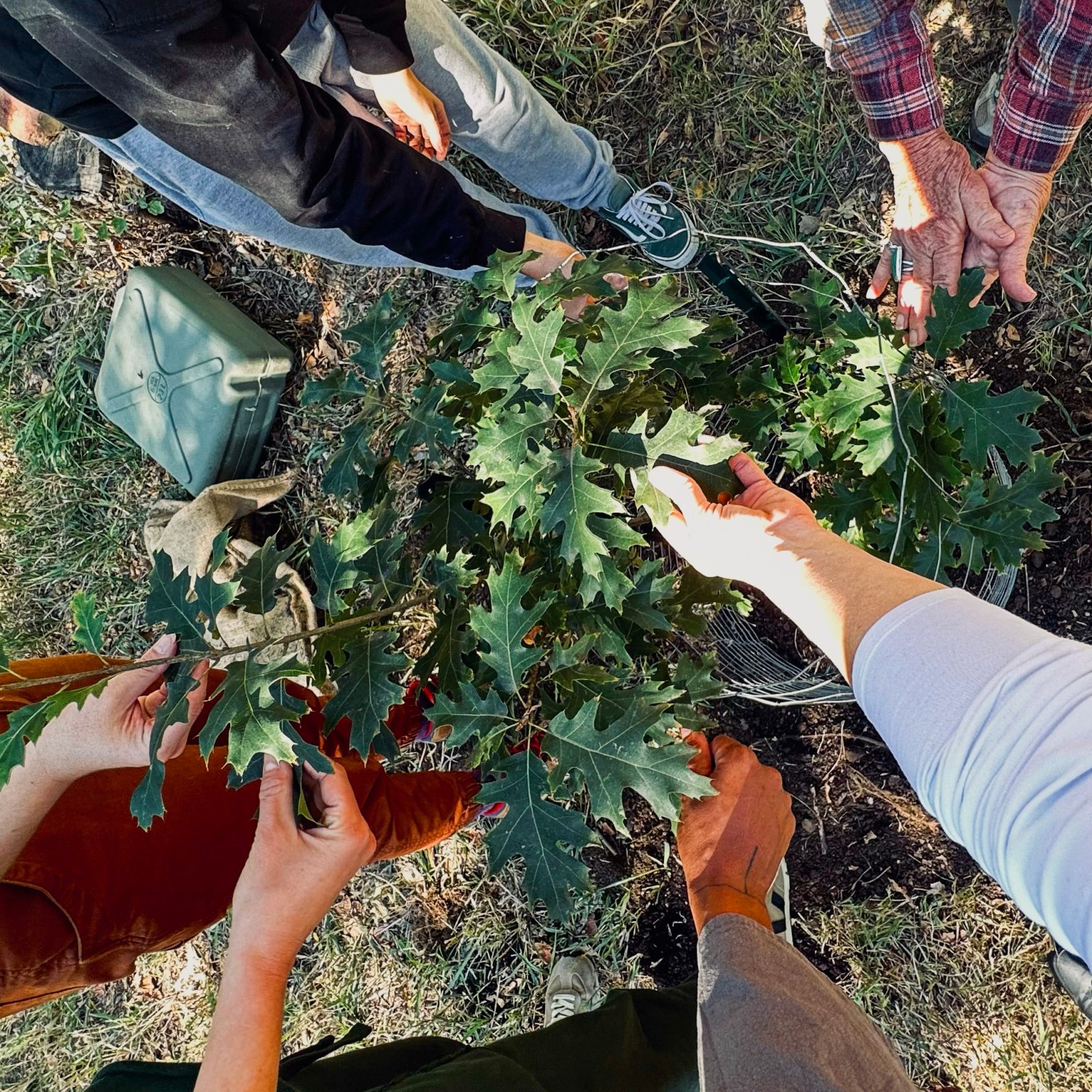
Planters offering a blessing.
Therefore, a variety of hardy and indigenous oak species became the priority, along with Kentucky coffee-tree (a favorite of pioneers as a coffee substitute), black cherry, western buckeye, basswood, hackberry, and disease-resistant elms. Native hickories are an excellent choice as well — but difficult to transplant; for these we have planted seed. Native maples (silver, boxelder) have been avoided as they are prone to storm damage; ash have been avoided because of pest and disease susceptibility.
Along with indigenous species, we have planted some non-native trees at the request of NSA as a trial. We have also planted a few trees that westward pioneers would have known back home and some that they would have seen along the way. Our last planting event was in fall of 2024. To date, we have planted around 300 trees with a survival rate of over 80%. An inventory of the trees planted by TNS was updated in spring 2026 by TNS ecology intern Alex Prideaux.

In order to assure quality, quick rooting, little watering, and overall resilience, we developed growing specifications to be used by our native nursery partners. In order to eliminate the need for watering after fall planting, we routinely plant small specimens. These are good for planting with school groups and other volunteers because no machinery and heavy lifting is required, and survival rate is high.
For the past 23 years, TNS has provided consulting and monitoring of the trees at PHC. We have also provided pruning and other care, held workshops and other educational events, and have demonstrated sustainable and low-cost planting methods — all on a volunteer basis and at the invitation of the PHC board. In addition to our planting and care specifications, we have demonstrated how minimal and careful pruning helps trees grow quickly and develop resistance to drought, breakage, and disease.
Our trees grow low branches to be gradually pruned over time. Allowing young trees to grow low branches — letting each individual develop naturally — is a distinctive feature of the PHC arboretum. Of course these low branches are temporary and are carefully pruned as clearance is required and when each individual tree is ready to develop a canopy.

Young trees (around 9 years old) are pruned in winter to create a canopy after they have a chance to grow.
The trees we have been planting at PHC and at our other arboretum sites and projects have been grown from seeds collected by our members from wild local trees. In fact, we have recently been able to collect seed from PHC arboretum to grow trees to be planted back on site. Some seed has also been collected to grow trees across the region. In addition to serving as an important educational resource (an “arboretum” is a place of learning, a school of ecology), we have become a vital source of seed for other native arboreta and habitat restoration projects in eastern Nebraska and western Iowa.
In June 2026 we hosted a tour for staff of the Nebraska Forest Service and Statewide Arboretum. PHC Arboretum was celebrated as a success story and an example to be followed by tree planters and arboretum curators across the region. It is a story to be celebrated by the Prospect Hill Cemetery board and by the wider community.

Members of the Naturalist School host yoga, meditation, and poetry circles at Prospect Hill Cemetery for the Omaha community. The trees we have planted help to make PHC a beautiful and welcoming place to gather.